


Hairpin with the image of a mountain goat. 17th–16th centuries. Sapallitepa
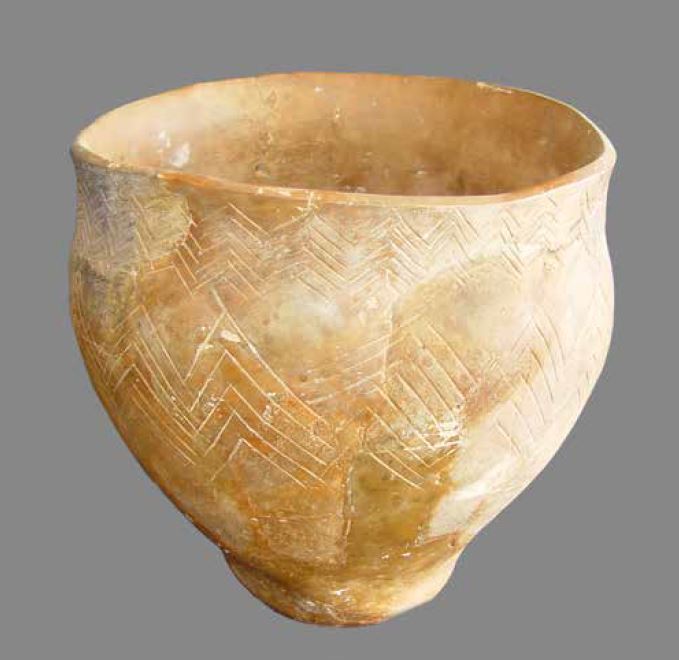
In the Bronze Age, the emergence of a proto-urban civilization is observed, which is characterized by the construction technique developed for its time, the addition of residential and monumental architecture techniques, the development of bronze casting and pottery. At this time, a number of large historical and cultural regions on the territory of Uzbekistan are gradually being formed and developed, on the one hand, there is an intensive progress in the cattle breeding of the tribes of the steppe circle, on the other –– the addition of the centers of the culture of irrigated agriculture. The artistic culture of the region took shape in the process of a wide interaction of tribes and peoples who lived on its territory with the adjacent cultures of the steppe East, Siberia, Mesopotamia, Iran, India and China. By the end of the 2nd millennium BC – the first half of the 1st millennium BC on the territory of modern Uzbekistan, several large historical and cultural regions are formed –– Bactria, Sogd, Chach, Khorezm, in which one can see the initial forms of states with an extensive system and hierarchy of political power. The very first large cities appeared during the 1st millennium BC. By the beginning of the 1st millennium BC in a number of regions of Uzbekistan, local agricultural regions are beginning to form. In each of the agricultural regions, along with scattered small villages, large, several hectares, urban–type settlements are formed, built according to a single plan, surrounded by defensive walls, and inside, divided by wide streets into residential quarters, craft, economic and religious complexes. The first examples of applied art in Uzbekistan date back to the time of the emergence of a sedentary agricultural culture, they were associated with the need to create artistic products intended mainly for everyday life. A significant number of cultural monuments of agricultural tribes of the Bronze Age have been investigated in the south of Uzbekistan. To date, the most detailed research has been carried out on the settlements of the 17th–10th centuries BC Sapallitepa and Jarkutan, the archaeological complexes of which made it possible to trace the paths of the formation and development of the proto-urban civilization of the ancient Eastern type, which entered into ethnocultural contacts with the tribes of both the ancient agricultural south and the cattlebreeding north. The development of bronze and the emergence of the potter’s wheel gaveimpetus to the improvement of handicraft production, to accelerate the process of urbanization on the territory of Uzbekistan. In the structure of settlements of this time, the rudiments of urban culture are visible - a fortified citadel, a sanctuary of fire, residential quarters with primitive buildings, artisan workshops. This period of Uzbekistan culture is represented by ceramics, bronze, stone and bone products. Two types of pottery have been recorded: the dyed pottery of the agricultural tribes of the south and the gray pottery of the steppe pastoralist tribes of the north. Each of the directions was distinguished by the originality of the pictorial and ornamental decor.Among the most interesting monuments in Uzbekistan are the painted ceramics of the Bronze Age from Chust and Shurabashat (Fergana Valley). The molded ceramics of various shapes are covered with engobe in different shades from light brown to black and polished.
The information was taken from the "History of the Art of Uzbekistan book - album".
Author: Academician Akbar Hakimov